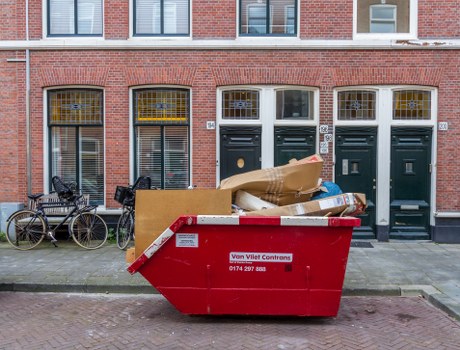
Health and Safety Policy — House Clearance Barking
Purpose: This policy sets out the commitment of our clearance and rubbish removal teams to protect the health, safety and welfare of employees, contractors, clients and the public during all house clearance and waste removal operations. It applies to all activities relating to household waste, bulky item collection, and general rubbish collection tasks carried out in our service area.Scope and Responsibilities
This policy covers operational staff, drivers, supervisors and temporary operatives engaged in house clearance, recycling and disposal activities. Managers have a duty to ensure risk assessments are completed, safe systems of work are implemented and that staff receive adequate training. Employees must follow procedures, wear specified personal protective equipment and report hazards. The organisation will provide resources to maintain safe working practices across its clearance services. Legal and Regulatory Context While avoiding extensive legal detail on this page, the company acknowledges obligations under applicable health and safety legislation and environmental regulations relevant to waste handling and rubbish removal. Compliance will be maintained through regular review, consultation with competent advisors and adherence to industry standards for safe handling, segregation and transportation of household and commercial refuse.
Risk Assessment and Safe Systems of Work
All house clearance jobs require a pre-work risk assessment to identify manual handling hazards, sharps, hazardous materials, trip and fall risks, and potential exposure to biological contaminants. Control measures must be documented and implemented before work begins. Safe systems include task planning, use of mechanical aids, clear access routes, and procedures for isolating and labelling hazardous items.Key controls to reduce risk include:
- Use of mechanical lifting aids and trolleys for bulky items;
- Appropriate PPE such as gloves, eye protection, masks and high-visibility clothing;
- Segregation and secure containment of hazardous waste;
- Vehicle loading practices that prevent shifting loads.
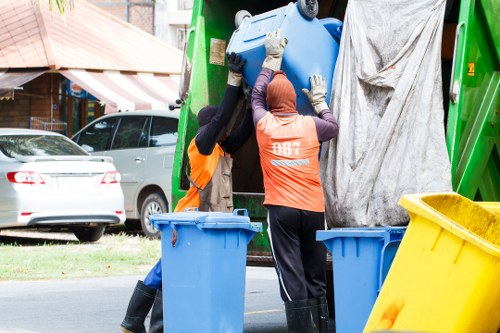 Personal Protective Equipment (PPE) The company will supply and require the correct PPE for tasks related to house clearance, rubbish collection and waste clearance services. PPE selection is based on the risk assessment and may include cut-resistant gloves, steel-toe boots, respiratory protection where dust or airborne contaminants are present, and suitable protective clothing. PPE must be inspected, maintained and replaced as needed.
Manual handling guidance emphasises team lifting for awkward loads, use of lifting aids and avoidance of twisting while carrying. Training in manual handling techniques, safe driving for crew members and correct use of containment systems will be provided. The company will maintain records of training and competency relevant to rubbish removal and clearance operations.
Hazardous and potentially contaminated materials (chemicals, asbestos containing items discovered during clearances, medical waste) will be treated with heightened controls. Staff must stop work and notify a supervisor if suspected hazardous materials are identified. Removal or disposal of certain hazardous items will be undertaken only by authorised contractors with specialist licences where required.
 Vehicles and Plant Safety Vehicles used for collection and clearance must be regularly inspected, loaded safely and operated by qualified personnel. Drivers must follow vehicle safety checklists, ensure securement of loads and comply with road safety requirements. Maintenance schedules for plant and equipment will be adhered to, and defects will be reported and serviced promptly.
Emergency procedures are in place for incidents such as injuries, spills or fires encountered during clearance work. These include first aid arrangements, spill containment kits for contaminant control and reporting protocols. Staff will be trained to implement emergency responses and to summon appropriate external emergency services when necessary.
Monitoring, Auditing and Continuous Improvement The organisation will monitor health and safety performance through routine site inspections, incident reporting and audits. Lessons learned from accidents, near misses and inspections will be used to update risk assessments, procedures and training. Continuous improvement is central to maintaining safe and efficient rubbish removal and clearance services.
 Record Keeping and Review Accurate records of risk assessments, training, equipment checks, incident reports and waste transfer documentation will be maintained. This documentation supports compliance, enables effective investigation of incidents, and informs regular policy review. The health and safety policy will be reviewed at least annually or when significant operational changes occur to ensure ongoing relevance to our house clearance operations and rubbish collection activities in the service area.
Summary of Commitments: We commit to protecting everyone affected by our operations by applying practical controls, providing appropriate equipment and training, and monitoring performance. This policy underpins a culture of safety for all of our clearance and waste removal teams.
Responsibilities: Management will provide leadership and resources; supervisors will enforce procedures; employees will act safely and report hazards. These shared responsibilities ensure a safe, legal and professional approach to house clearance and rubbish removal services.
Review and Approval: This policy is endorsed by senior management and will be communicated across the organisation. It is a living document that will evolve as practices, regulations and service needs change, ensuring safe and responsible clearance and rubbish collection throughout our operational area.